I recently had the pleasure of sitting in on a Zoom webinar centred around the necessity of masks as we return to the dance studio and best practices to make this smooth transition. Speaking on the subject were Dr. Linda Bluestein, the Hypermobility MD, Dr. Julia Iafrate, and Dr. Meghan Meier, The Dance Doctor and Company Physician at the Oklahoma City Ballet. While this was a community webinar, their words included in my summary below were rooted in education and experience, though are not giving explicit advice nor guarantee of outcome. As a responsible dancer/dance educator, I sought out additional information on the subject and have continued to do so, as we continue to learn more about COVID-19 and the implications of both the disease itself and preventative measures.
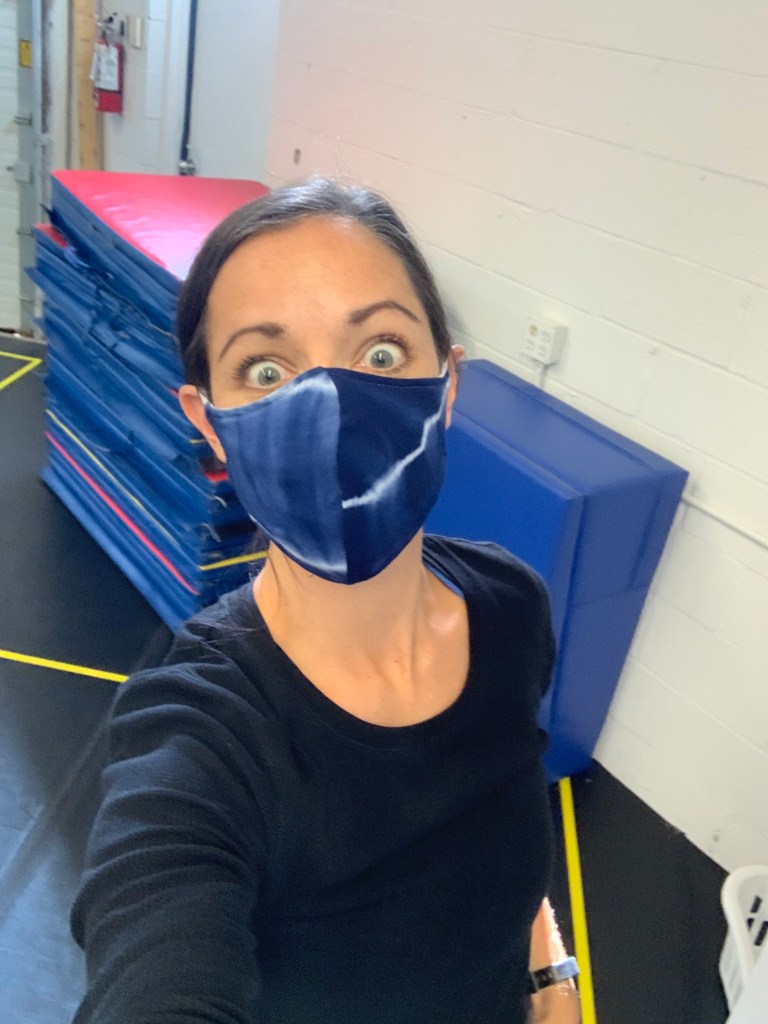
Mask made by talented dancer and seamstress, Lindzie. Comment below for details on how to get you very own!
The only thing better than a doctor for dancers is a doctor who was a dancer, and I feel so fortunate to have been able to listen to a medical professional speaking from experience and understanding, as well as research and knowledge. So, what did I learn?
First, YES, masks are necessary and should be worn by all in the studio, but even more important were the why?, how?, and what ifs? that they tackled in this wonderfully informative session.
A few things we need to remember:
Approximately 50% of COVID carriers are asymptomatic, so when we hear things like “I haven’t coughed” or “I feel fine”, we have to remember that this doesn’t reduce our risk of contracting a virus that may not be serious for us, but may put the health of others in jeopardy. We also do not know the long-term effects of this illness so flippant disregard is unjustifiable at this point.
It has been noted that the suggestion that masks were unnecessary nor helpful was made either in error and/or in effort to preserve personal protective equipment (PPE) for those with greatest need (I.e. healthcare workers). A demographic that doesn’t lightly admit mistake is openly and honesty doing so; I’m thinking we should listen. I’ve included an infographic at the end of this entry that illustrates the risk level of COVID transmission with or without a mask. I’ve carefully selected a version that does not include percentages as this data is not actually conclusive. On an anecdotal level, I have also included a CDC infographic, developed after two symptomatic hairstylists in Missouri saw 139 clients while wearing masks and transmission [where known symptoms were detected] did not occur. This doesn’t mean you should take symptoms for a masked adventure should they arise, just that we can look at this information and hypothesize that masks are indeed effective.
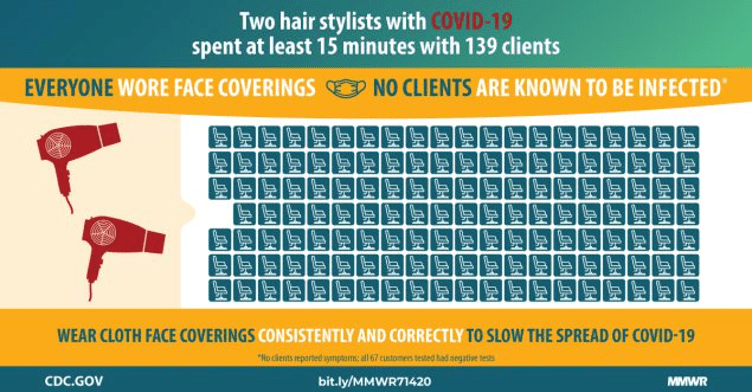
Image borrowed from CDC.GOV
6 feet may not be enough!
While the six-foot rule is effective for casual encounters, it may not be enough in situations where we are speaking at a higher volume, singing, or breathing heavily due to heightened exertion, for instance…DANCING!
The six feet rule does not suggest an impermeable barrier through which infected respiratory droplets cannot travel. Any time we are more forcefully exerting sound or breath our droplets are reaching much farther than when engaging in a distant social call. This doesn’t mean we can’t work within our six-foot space, rather that additional precautions are advised. Masks can limit the spray of these droplets to just a few inches!
One of my favourite suggestions was to simply assume that we all have cooties, which in turn offers a very appropriate segue to my next point:
Are masks safe for children?
It seems that yes, provided the child can do two things:
1) Tell you if the mask is uncomfortable or bothersome.
2) Adjust the mask themselves.
The government is not requiring children from 2-5 to wear masks, but as long as a good fit can be achieved and the child is able to do the above (even try teaching them!), they should be fine in their mask. While infection rate among this demographic is currently lower, we are constantly learning about this virus and it’s non-discriminating reach. I know that parents would go to the ends of the earth to protect their children, and masks seem like a much better and less life-consuming option.
Speaking about size, masks are not a one size fits all solution when it comes to a) the actual fit to our varying face shapes, and b) the different masks we wear for different activities. What works for the grocery store, may not be appropriate for high intensity dancing.
Here are a couple of tips and tricks to help you select the best mask for you or your child to wear during dance classes:
1. Simple cloth masks may be sucked into the mouth during deep inhalation. Look for adjustable nose-pieces, darts, and well-shaped masks that make space for the nose and chin.
2. Plastic mask inserts are available to help keep the mask away from the face. This also may help with low levels of claustrophobia. *UPDATE – I live for my little Hannibal Lector mouth cages!*
3. N95 masks with valves do not prevent others from breathing your particles (in essence, the opposite of the cloth masks) so if you go this route, it would be wise to wear a cloth or disposable surgical mask on top.
4. Pay attention to different fabric material, thickness, etc. As I’m sure anyone that lived through the 70’s well knows, polyester doesn’t breathe nearly as well as cotton!
5. Keep an eye out for masks marketed to athletes (but keep up your discerning intuition) and have a look at the benefits they boast to see whether or not they may be a good fit.
Once you’ve found the perfect mask (and this may be a game of trial and error), keep the following in mind:
– Change your mask between classes or if it has become damp or wet (esp. teachers who will be talking more than students).
-Wetness can inhibit the flow of oxygen.
-Level of intensity DOES affect air flow, so if you are deconditioned or fatigued, you may experience increased oxygen requirements as well as an increase in carbon dioxide production. We can prevent/combat this by working on gradually getting used to our masks. Much like breaking in Irish hard shoes or Ballet pointe shoes, a dancer can wear their mask around the house for short periods, gradually increasing exercise activity to teach their bodies to adjust before training intensely in class. Think about high performance athletes or military personnel who train themselves to achieve in different climates, with varying equipment, and even decreased O2 availability. It is possible to train our systems to rise above.
-By practicing at home, we can learn to cope with varying levels of airflow (in environment) and varying temperatures.
-This is also good practice to adjust the response of our autonomic nervous system, bettering a student’s ability to cope with anxiety. As with anything, this requires dedicated training and effort.
As you did with any of your dance skills, you have to train yourself to get good at masks!
Now, the virus cares not whether we are at home, in class, taking photos, or in performance.
A few best practices are noted below, but the list goes on:Avoid partnering or floorwork until we know a bit more. Spaces are mapped out to keep us separate and therefore safe. Because we cannot maintain consistent cohort bubbles or pods due to a number of activities, school and family commitments, it is best to abstain.
-Choreography can be designed or adjusted to maintain social distancing as an added precaution with our masks. We are artists and creative beings and we can figure this out.
-Gloves are not advised as they tend to cause slipping and oddly enough, promote poorer hand hygiene. Washing hands before AND after class will best protect dancers, teacher, families, and anyone else with whom we come in contact.
-A mask should be considered soiled if it is taken off and set on a ‘random’ surface. A change of mask will keep us fresh, happy, and also prevent “maskne” (mask acne). If make-up is not needed, make-up should not be worn.
-Soiled masks should be kept in a small laundry bag when removed and a fresh mask should be available in another bag. Don’t keep you mask next to your dance shoes, because that is just, well…gross.
-While hand sanitizer is a bit of a catch-22 as it kills off the good bacteria with the bad, it is not a bad idea to use prior to donning and doffing (removing) your mask. Always remove the mask by the ear pieces to avoid further contaminating the mouth piece.
-Photos are best done socially distant and in masks. If photos are necessary, show pride in your care for yourself and your community by staying cautious even when on camera.Some people are concerned that masks may make you sicker, but the reality is that anything you are breathing out into your mask space was already in your person and will not cause new illness or exacerbate existing.What can we do to make wearing masks a bit easier?
Potential Issues:
-Confusion
-Shortness of breath
-Air hunger
-Dehydration
-Feeling overheated
-Light-headedness
-Colour change *severe symptom before which any of the above are likely to occurHow to manage?
-Stay hydrated
-Take a mask break in a safe space
-Gradually build up to wearing masks
-Replace wet masks with dry
– Replace cloth mask with disposable surgical masks where necessary (little resistance to O2)
For those who absolutely cannot wear masks because of LEGITIMATE concerns, health or mental illness, please consider the following:
1.There are options. If a mask doesn’t feel right, there are slightly less effective (but better than nothing) options such as a balaclava over the mouth and or a face shield. Keep in mind that the shield doesn’t protect droplets from descending but is again, better than nothing.
2.A safe space can be created in which a dancer can take a moment, remove theirmask, and take a breath. This allows for a sense of control and the knowledge of an exit strategy if the thought of masks cause any level of anxiety. This special corner of the room would of course be sterilized between classes to ensure safety.
3.When you see someone without a mask, approach the situation with care and concern, rather than frustration and anger. We can be “strictators”, not dictators as we help troubleshoot while maintaining appropriate safety measures.
4.Just because you may not know anyone who has contracted the virus, are not high risks for complications, or see others not-complying with suggested safety measure, doesn’t mean that there is no longer a threat.
5.DANCE IS A PRIVILEGE and while many sports are not returning until spring, we have been blessed with the ability to go back now. Let’s do it right so we can stay in business and keep dancing our hearts out.
Recommendations and safety measures may change over the season so patience and open-mindedness are key. Our knowledge is ever-evolving and with it, appropriate practice. Dance is a privilege – let’s treat it as such!
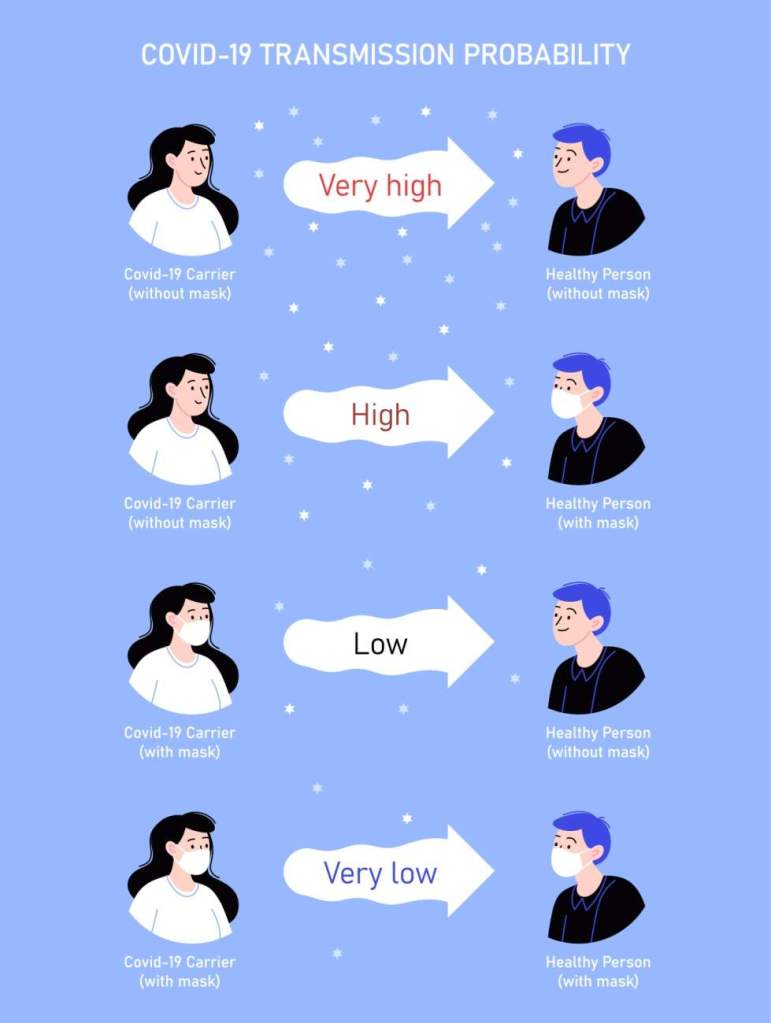
Infographic: Doctors South of Melbourne
Kellie Nuovo – November, 2020.
 Homebody Movement Lab